What is the Human-Centered AI Service Management Framework (HUCAISM)?®)?
If AI takes over certain services, who is responsible?
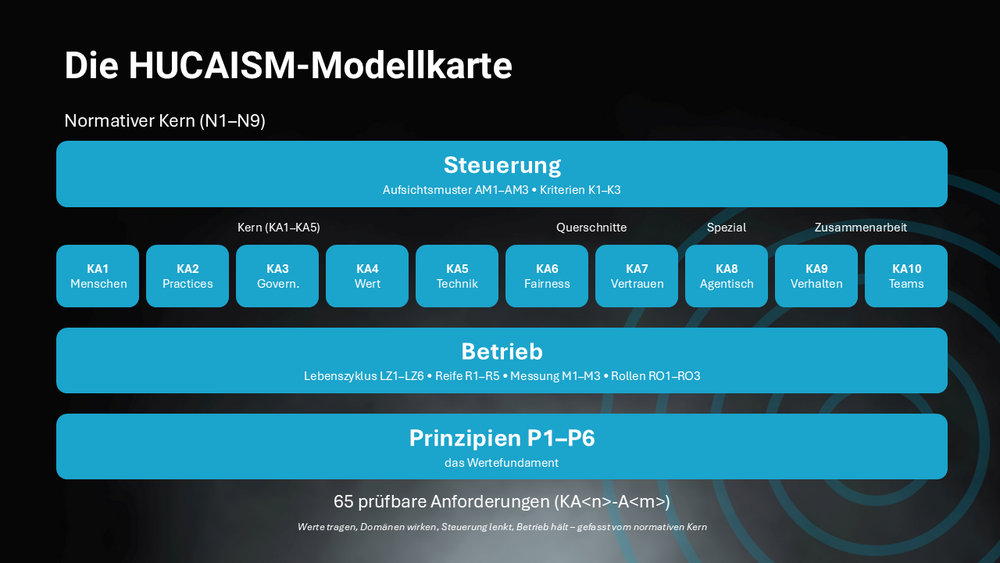
Artificial intelligence is transforming how services are created and delivered faster than traditional service management frameworks and AI governance standards can keep up. It is precisely in this gap that problems arise: AI-powered services that belong to no one and for which no one takes responsibility when something goes wrong. The HUCAISM framework closes this gap. Human-Centered AI Service Management is the discipline and operational model that organizations use to design, deliver, and manage AI-powered services in a way that keeps human judgment, human responsibility, and human value at the center. HUCAISM combines the best practices of service management with the requirements of AI governance into a consistent operational approach. HUCAISM is a framework developed by SERVIEW GmbH. It comprises 6 principles, 10 domains with 65 verifiable requirements, 3 oversight models, 6 lifecycle phases, and 5 maturity levels.
The framework comprises 6 principles, 10 domains, and 65 verifiable requirements, supplemented by 3 oversight models, 6 life cycle phases, and 5 maturity levels.
About the HUCAISM Professional Training Course with SERVIEW
Why is HUCAISM needed?
AI-powered services differ fundamentally from traditional services in three key ways:
- They operate on a probability-based basis. They may give different answers to the same question, and they sometimes produce results that are convincingly worded but factually incorrect.
- They change as they are used. New model versions, modified prompts, or new knowledge alter their behavior, often without anyone noticing.
- They pass the buck. With the vendor, IT, and the business unit all involved, it quickly becomes unclear who is accountable for the outcome.
Traditional service management was developed for largely predictable systems. AI governance often focuses on the AI system itself and its regulatory classification. The practical question often remains unanswered: How is each individual AI-powered service managed, monitored, improved, and, if necessary, taken offline during day-to-day operations? This is exactly where HUCAISM comes in. It translates governance, risk, and compliance requirements into day-to-day operations.
The Six Principles: Decision-Making Rules, Not a List of Values
The principles of HUCAISM are decision-making rules for situations in which two legitimate goals conflict, such as efficiency and human oversight, or speed and care.
- Responsibility cannot be delegated. For every AI-powered service, it is clear who is accountable. “The AI decided that” is not an acceptable answer.
- Augmentation before substitution. AI first enhances humans rather than replacing them. Full automation is a conscious decision, not the default path.
- Transparency in the service, not just in the model. It must be clear how a service arrives at its results—for users, operators, and auditors.
- Value is created for people. Success is measured by the problems solved and the trust built, not just by throughput.
- Governance by Design. Regulatory and ethical requirements belong in the design phase, not in the revision phase.
- Supervised learning. AI-powered services should be allowed to improve, but only in a controlled manner and with a proven fallback plan in case of an emergency.
The Ten Domains: Where the Model Is Effective
The ten domains represent HUCAISM's areas of focus. They encompass the 65 verifiable requirements.
Five core domains underpin every AI-powered service:
- DO1 – People & Roles: Who is responsible, who oversees, who operates. And why oversight without expertise and time is merely a facade.
- DO2 – Practices: How incident, problem, change, and other familiar practices change once AI is involved. For example, why a hallucination is an incident and a prompt change is a change.
- DO3 – Governance & Compliance: The EU AI Act and ISO/IEC 42001 as design parameters rather than burdens, with a directory of all AI services serving as the foundation.
- DO4 – Value & Experience: Output vs. Outcome. Why rising metrics can be misleading, and why silent errors are more dangerous than obvious ones.
- DO5 – Technology & Data: Models, Data, Drift, Monitoring, and Recurrence Curves from an Operational Perspective.
Two cross-cutting domains influence all the others:
- DO6 – Fairness & Bias: Why Every Service Needs a Deliberately Chosen and Documented Fairness Standard.
- DO7 – Trust & Human Factors: Automation Bias, Trust Calibration, and the Successful Handoff Between Human and Machine.
One area of specialization involves situations where AI acts on its own:
- DO8 – Governance of Agent-Based Systems: Limits of Autonomy, Scope of Influence, and the Tested Emergency Shutdown.
Two areas govern the collaboration between humans and machines:
- DO9 – Interaction & Behavior: When AI speaks, remains silent, asks questions, or takes the initiative to hand things over, and what information it is allowed to retain about a person.
- DO10 – Hybrid Teams & Orchestration: People, AI agents, and automation as a single operational unit, with a designated person orchestrating their interaction.
How closely humans stay involved: Supervision and Operations
For each AI-powered service, HUCAISM determines the extent to which human oversight is required. There are three oversight models to choose from:
- Human-in-the-Loop: People make the decisions.
- Human-on-the-Loop: The AI acts, while humans monitor and intervene.
- Human-out-of-the-loop: The AI acts autonomously within narrow limits.
Which model applies is determined by three criteria: impact, reversibility, and regulatory framework.
A six-phase life cycle guides every service from planning through decommissioning. Five maturity levels indicate where an organization stands. Three core roles—AI Service Owner, Oversight, and Governance—clarify who is accountable, who monitors, and who enforces the rules.
Who HUCAISM is for:
HUCAISM is intended for anyone who is responsible for, designs, operates, or uses AI-powered services and digital products: service managers, executives, consultants, and professionals in IT, compliance, and line of business. A technical background is not required. A foundation in service management—ideally using ITIL—is helpful. The version does not matter, as HUCAISM is built on the common core of these practices.
Positioning: A Partner, Not a Rival
HUCAISM is explicitly intended to complement existing frameworks, standards, and laws, not to replace them.
- ITIL: HUCAISM builds on proven practices. It does not redefine incident, change, or service level management, but rather describes how these concepts change once AI is involved. ITIL Version 5, with its AI governance module, identifies the risks associated with AI and the controls an organization can implement. HUCAISM provides the “how” for each individual AI-supported service: what oversight applies, how the practices change, and how to verify compliance.
- ISO/IEC 42001: The standard for AI management systems serves as the organizational framework. HUCAISM is the layer below it that brings this framework to life through day-to-day operations.
- EU AI Act: The legal framework sets out the requirements. HUCAISM translates these requirements into concrete design and operational decisions. Legal interpretation remains the responsibility of legal professionals.
You're familiar with your ITIL practices. But are you aware of the impact of AI?
You’re familiar with ITIL. Incidents, changes, service requests, knowledge management—all familiar territory. But as soon as AI starts playing a role in decision-making for your services, these practices begin to behave differently than you’re used to. Here are a few examples:
- An incident where nothing goes down. Your assistant is available, fast, and runs flawlessly—yet still provides a convincingly wrong answer. Traditional monitoring doesn't pick up on this. Is that already an incident?
- A change that nobody requested. The platform provider updates the system overnight—and suddenly your service behaves differently. Who approves this when nobody was asked?
- A problem that can't be "fixed." Sometimes the problem isn't in a line of code, but in a property of the model itself. What does problem management do when there isn't a bug?
- A configuration item that is not a server. What exactly is being configured when a CI defines the service?
- An SLA that no longer guarantees accuracy. What do you tell a customer when the service can only make an educated guess?
HUCAISM doesn't reinvent your practices—it shows you where you need to rethink your approach once AI comes into play. HUCAISM walks you through every single practice: which new triggers, categories, and controls are added, and what specific adjustments you need to make.
A model to follow, not a checklist to work through
The principles form the foundation; the domains form the structure built upon it. The model is supplemented by a governance layer (three oversight models) and an operational layer (lifecycle, maturity levels, measurement levels, roles)—all framed by a normative core that definitively establishes what applies. Organizations enter the model at the point where their own pain lies—usually an overlooked incident or a question that no one could answer—and from there, they discover what else is involved.
From AI System to Responsible Service: HUCAISM Professional
To properly understand HUCAISM and apply it to specific AI-powered services, a solid understanding of the model is essential. This is exactly where the HUCAISM AI Service Professional training course comes in.
The HUCAISM Professional course teaches the fundamentals of the model, explains its six principles, eight domains, roles, and oversight patterns, and provides practical guidance on how to design, operate, measure, and manage AI-enabled services. It is intended for specialists and executives in service management, AI governance, risk, compliance, and management, as well as anyone responsible for AI-enabled services and digital products.
HUCAISM Professional thus provides a comprehensive introduction to HUCAISM—from structured classification and practical application to preparation for human-centered, transparent, and auditable AI operations.
What is ... ? We'll explain!
Learn, in simple terms, what lies behind the frameworks, methods, and standards:
Are you familiar with our in-person training courses?
We also offer all HUCAISM training courses in the following cities or at
as Virtual Classroom .
See for yourself: SERVIEW Benefits

's On-Time Delivery Guarantee: 100% Reliable
Uncompromising reliability with the SERVIEW On-Time Guarantee. Plans derailed, last-minute cancellations, headaches? Not with us!

SERVIEW
: Audit Assurance
A secure environment for taking your exam and a free retake if you do not pass.

Maximum flexibility:
SERVIEW Training Formats
Our training courses come in a wide variety of formats—there's something for every type of learner!